

Introduction
Over the last decade, I have witnessed a remarkable shift in how economies create value, compete globally, and deliver public services. When I first began studying economic development and urban transformation, digital technologies were largely viewed as supporting tools that improved efficiency. Today, they have become the foundation of economic growth itself.
Whether we are discussing artificial intelligence, cloud computing, digital payments, e-commerce, or smart cities, the common thread connecting these developments is the Digital Economy.
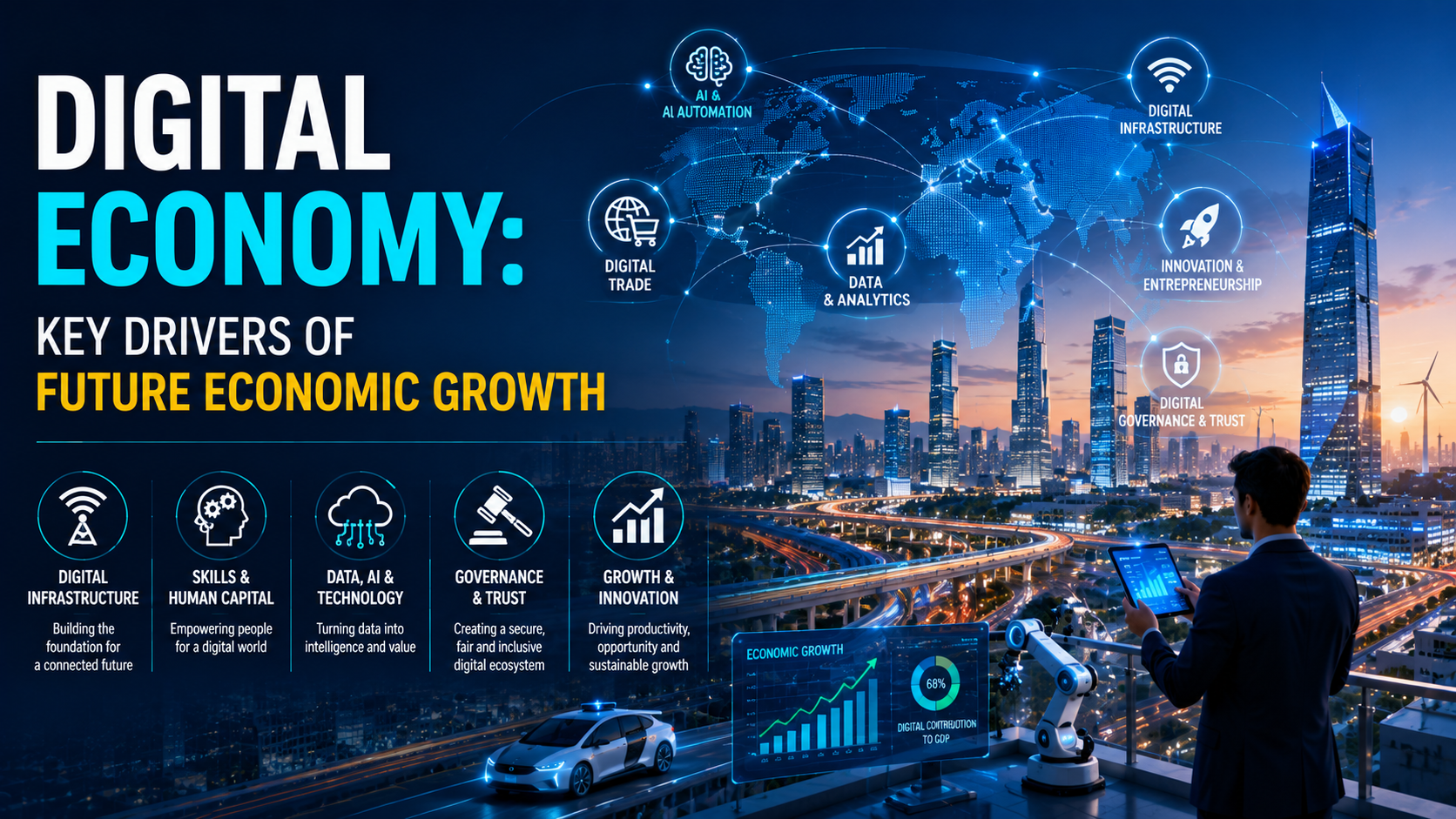
The Digital Economy encompasses far more than online shopping or technology companies. It includes all economic activities that rely on digital technologies, internet connectivity, data, and digital platforms. Increasingly, economic growth is driven not by physical assets alone but by data flows, digital infrastructure, knowledge networks, and innovation ecosystems.
Governments across the world are investing heavily in digital transformation because they recognize that future competitiveness will depend on digital readiness. Businesses are adopting advanced technologies to increase productivity and reduce costs. Citizens are becoming increasingly connected through digital services, mobile applications, and smart devices.
In Saudi Arabia, the Digital Economy has become a central pillar of Vision 2030, supporting economic diversification, innovation, and private-sector growth.
This article explores what the Digital Economy is, its core pillars, the drivers behind its rapid growth, and why it has become one of the most important forces shaping economic development in the twenty-first century.
What Is the Digital Economy?
The Digital Economy refers to economic activities that are enabled, enhanced, or transformed through digital technologies, data, and internet connectivity.
Unlike traditional economies that depend primarily on physical infrastructure and tangible assets, the Digital Economy derives value from information, connectivity, software, and digital platforms.
Examples include:
- E-commerce platforms
- Digital banking and fintech
- Cloud computing services
- Artificial intelligence applications
- Digital media and content creation
- Online education
- Smart city technologies
- Digital government services
What makes today’s Digital Economy particularly transformative is its ability to connect individuals, businesses, governments, and machines in real time.
A decade ago, digitalization often meant creating a website or automating a business process. Today, organizations operate within interconnected digital ecosystems where data flows continuously between customers, suppliers, service providers, and governments.

The Evolution of the Digital Economy
From E-Commerce to Intelligent Ecosystems
The Digital Economy has evolved through several distinct phases.
Phase One: Internet and E-Commerce
The first wave focused on connecting consumers and businesses through the internet. Online marketplaces transformed retail and created entirely new business models.
Phase Two: Mobile Technology and Cloud Computing
The widespread adoption of smartphones and cloud computing expanded digital access significantly. Businesses could now operate globally while customers accessed services anytime and anywhere.
Phase Three: Big Data and Artificial Intelligence
Organizations began leveraging massive amounts of data to improve decision-making, automate processes, and personalize services.
Phase Four: Connected Digital Ecosystems
Today, technologies such as artificial intelligence, the Internet of Things (IoT), blockchain, and digital twins are creating intelligent ecosystems capable of real-time interaction and autonomous decision-making.
In my own observations of economic development projects, one of the most significant changes has been the shift from digitizing individual processes to digitizing entire economic systems.
Core Pillars of the Digital Economy
The Digital Economy relies on several interconnected pillars that enable innovation, productivity, and economic growth.
Digital Infrastructure
Digital infrastructure serves as the backbone of the Digital Economy.
Without reliable connectivity and technological foundations, digital transformation cannot occur at scale.
Key components include:
- High-speed broadband networks
- 5G mobile technology
- Data centers
- Cloud infrastructure
- Secure national digital networks
Countries that invest heavily in digital infrastructure often experience faster innovation, higher productivity, and greater competitiveness.
Just as roads and ports powered industrial economies, digital infrastructure powers modern economies.

Data, Artificial Intelligence, and Software Ecosystems
Data has become one of the most valuable economic assets in the modern world.
Organizations increasingly rely on:
- Big Data analytics
- Artificial Intelligence (AI)
- Machine Learning
- Cloud Computing
- Enterprise Software Platforms
Artificial intelligence is transforming industries by enabling predictive analytics, intelligent automation, and data-driven decision-making.
Examples include:
- Predictive maintenance in manufacturing
- Personalized healthcare solutions
- Smart transportation systems
- Automated customer service platforms
The organizations generating the greatest economic value today are often those capable of transforming data into actionable insights.
Digital Skills and Human Capital
Despite rapid technological advancements, people remain the most important asset in the Digital Economy.
Technology alone cannot create innovation.
Success depends on a workforce capable of:
- Using digital tools effectively
- Interpreting data
- Developing software solutions
- Managing cybersecurity risks
- Leveraging AI technologies
One challenge I consistently encounter in economic development projects is the growing gap between technological capability and workforce readiness.
Many countries possess advanced infrastructure but continue to face shortages of:
- Data scientists
- AI specialists
- Cybersecurity professionals
- Cloud architects
- Digital project managers
Bridging this skills gap has become a strategic priority for governments and businesses alike.
Digital Governance and Trust
Trust is one of the least discussed but most important pillars of the Digital Economy.
Consumers and businesses will only participate fully in digital ecosystems if they trust that their data is secure and their rights are protected.
Effective digital governance includes:
- Cybersecurity frameworks
- Data privacy regulations
- Consumer protection laws
- Digital competition policies
- Responsible AI governance
Strong governance frameworks create confidence, encourage investment, and support sustainable digital growth.
Without trust, digital adoption slows considerably.
Why These Pillars Matter
The four pillars—digital infrastructure, data and software, digital skills, and governance—are mutually reinforcing.
A country may have excellent connectivity, but without digital talent, innovation remains limited.
Likewise, advanced technologies cannot achieve their full potential without regulatory frameworks that foster trust and security.
The most successful digital economies recognize that technological investment must be accompanied by investments in people, institutions, and governance systems.
Key Drivers Accelerating Digital Economy Growth
The rapid expansion of the Digital Economy is not occurring by chance. Several powerful forces are driving its growth across developed and emerging economies alike.
Global Digital Trade
One of the most transformative developments in recent years has been the rise of digital trade.
Traditionally, international trade involved the movement of physical goods across borders. Today, an increasing share of economic value is created and exchanged digitally through software, cloud services, digital content, financial technologies, and online platforms.
Digital trade allows businesses to reach global markets without establishing a physical presence in every country. Small and medium-sized enterprises (SMEs) can now access customers worldwide through digital platforms, reducing barriers to international expansion.
Regional initiatives such as the Digital Economy Framework Agreement (DEFA) are designed to facilitate cross-border data flows, harmonize digital regulations, and strengthen regional digital ecosystems. Such agreements are expected to significantly expand digital trade volumes and create new opportunities for businesses operating in the digital space.
From an economic development perspective, digital trade lowers transaction costs, increases market access, and enhances productivity, making it a major driver of future economic growth.
Supply Chain Transformation
The Digital Economy is fundamentally changing how value is created and delivered.
Historically, supply chains operated as linear systems where information moved slowly between suppliers, manufacturers, distributors, and customers. Today, digital technologies are transforming these systems into interconnected ecosystems.
Traditional vs Digital Supply Chains
| Traditional Supply Chain | Digital Ecosystem |
|---|---|
| Sequential processes | Real-time integration |
| Limited visibility | End-to-end transparency |
| Reactive management | Predictive decision-making |
| Manual coordination | Automated workflows |
| Periodic reporting | Continuous monitoring |
Technologies such as AI, IoT, cloud computing, and blockchain enable businesses to monitor operations in real time, identify disruptions before they occur, and optimize resource allocation.
The COVID-19 pandemic highlighted the importance of supply chain resilience. Organizations that had invested in digital technologies were generally better positioned to respond to disruptions and maintain operational continuity.
Digital Taxation and Public Revenue
Governments are increasingly leveraging digital technologies to improve revenue collection and fiscal management.
Digital platforms generate extensive transaction data that can help tax authorities improve compliance, reduce tax leakage, and increase transparency.
Examples include:
- Electronic invoicing systems
- Digital tax reporting platforms
- Integrated payment systems
- Real-time transaction monitoring
These systems not only enhance public revenue collection but also reduce administrative burdens for businesses.
In many countries, governments are integrating tax systems directly with e-commerce platforms, enabling more accurate reporting and improving the efficiency of revenue administration.
How the Digital Economy Creates Economic Value
The Digital Economy contributes to growth through several interconnected mechanisms.
Increased Productivity
Productivity improvements remain one of the most important economic benefits of digital transformation.
Digital technologies enable organizations to:
- Automate repetitive processes
- Improve operational efficiency
- Reduce transaction costs
- Enhance decision-making
- Optimize resource allocation
Higher productivity ultimately supports economic growth, wage increases, and improved competitiveness.
Innovation and Entrepreneurship
The Digital Economy lowers barriers to market entry and enables entrepreneurs to launch businesses with relatively limited capital.
Digital platforms provide access to:
- Customers
- Payment systems
- Marketing channels
- Cloud infrastructure
- Business intelligence tools
As a result, startup ecosystems are emerging across many regions of the world.
Employment Creation
Contrary to common concerns that technology only eliminates jobs, the Digital Economy is also creating entirely new categories of employment.
Examples include:
- AI specialists
- Data analysts
- Cybersecurity experts
- Digital marketers
- Software developers
- Cloud engineers
- Digital product managers
While some routine jobs may be automated, new opportunities continue to emerge in high-value digital sectors.
Enhanced Competitiveness
Countries and cities with advanced digital ecosystems tend to attract greater investment, innovation, and entrepreneurial activity.
Digital readiness has become a major factor influencing location decisions for businesses, investors, and skilled professionals.
Saudi Arabia’s Digital Economy Transformation
Digital Economy as a Vision 2030 Priority
Saudi Arabia has placed the Digital Economy at the center of its economic diversification strategy.
Recognizing that long-term competitiveness requires a transition toward a knowledge-based economy, the Kingdom has made substantial investments in digital infrastructure, innovation, and technological development.
Vision 2030 explicitly emphasizes digital transformation as a key enabler of economic modernization and private-sector growth.
Institutional Leadership
Two institutions have played particularly important roles in advancing the Kingdom’s digital transformation agenda.
Communications, Space and Technology Commission (CST)
The CST has been instrumental in:
- Expanding telecommunications infrastructure
- Enhancing digital connectivity
- Promoting emerging technologies
- Supporting innovation ecosystems
Ministry of Communications and Information Technology (MCIT)
MCIT has led initiatives focused on:
- Digital transformation
- Human capital development
- Digital entrepreneurship
- Artificial intelligence adoption
- Innovation-driven growth
Together, these institutions are helping build a robust foundation for the Kingdom’s Digital Economy.
Building World-Class Digital Infrastructure
One of Saudi Arabia’s most notable achievements has been its rapid expansion of digital infrastructure.
Major investments have focused on:
- Nationwide fiber networks
- 5G deployment
- Cloud computing services
- Data center development
- Digital government platforms
These investments are creating the infrastructure required to support future economic growth and technological innovation.
Smart Cities and Digital Innovation
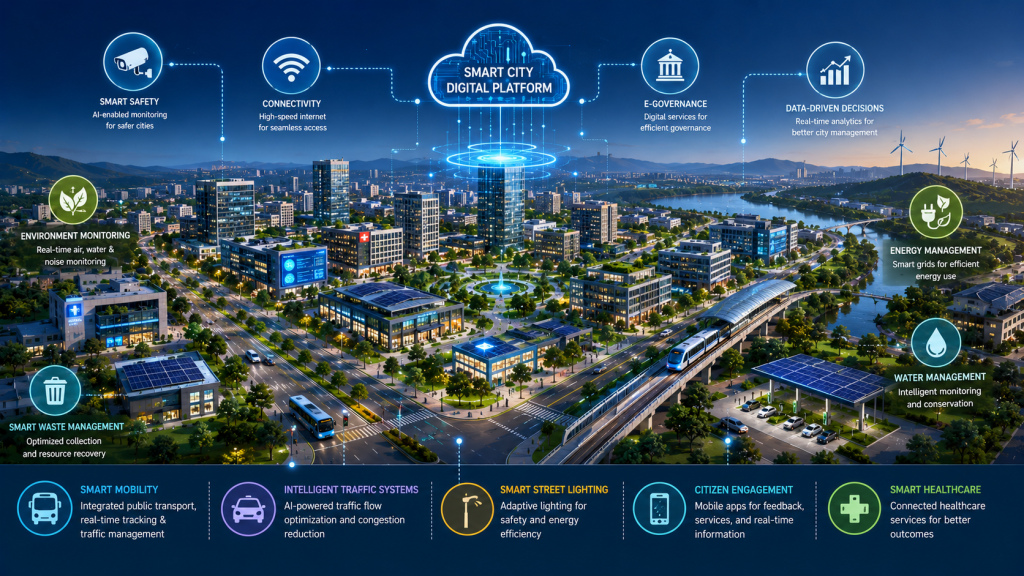
The relationship between smart cities and the Digital Economy is becoming increasingly important.
Large-scale urban development initiatives such as NEOM are being designed around advanced digital technologies from the outset.
Smart city technologies include:
- IoT-enabled infrastructure
- Intelligent transportation systems
- Smart utilities
- Digital public services
- AI-powered urban management
These technologies improve efficiency while enhancing quality of life for residents.
Opportunities for Saudi Businesses
The growth of the Digital Economy presents significant opportunities across the private sector.
Small and Medium-Sized Enterprises
SMEs can benefit from:
- E-commerce expansion
- Digital marketing
- Cloud-based business tools
- Digital payment systems
Large Enterprises
Larger organizations are increasingly investing in:
- AI solutions
- Automation technologies
- Advanced analytics
- Digital transformation initiatives
Startups
Saudi Arabia’s startup ecosystem continues to expand across sectors including:
- FinTech
- HealthTech
- EdTech
- Logistics
- Smart mobility
Challenges Facing the Digital Economy
Despite substantial progress, several challenges remain.
Digital Skills Gap
The demand for digital talent continues to exceed supply in many markets.
Governments, universities, and businesses must work together to strengthen digital skills and workforce readiness.
Cybersecurity Risks
As digital systems become more interconnected, cybersecurity threats become increasingly sophisticated.
Organizations must invest in:
- Cybersecurity infrastructure
- Risk management systems
- Data protection measures
Regulatory Complexity
Policymakers face the challenge of balancing innovation with consumer protection and market stability.
Regulatory frameworks must evolve alongside technological developments.
Digital Inclusion
Ensuring equitable access to digital opportunities remains critical.
Without inclusive policies, digital transformation may widen existing socioeconomic disparities.
Future Trends Shaping the Digital Economy
Several trends are likely to influence the next phase of digital transformation.
Artificial Intelligence Everywhere
AI is expected to become embedded across virtually all industries, supporting automation, forecasting, and decision-making.
Expansion of the Internet of Things
Billions of connected devices will generate vast amounts of data and enable smarter operations.
Digital Twins
Digital replicas of physical assets and systems will improve planning, monitoring, and optimization.
Autonomous Systems
Advances in automation will transform transportation, logistics, manufacturing, and urban services.
Platform Economies
Digital platforms will continue to dominate value creation by connecting users, businesses, and service providers.
Strategic Recommendations
For Governments
- Continue investing in digital infrastructure.
- Strengthen cybersecurity frameworks.
- Promote digital inclusion.
- Modernize regulatory systems.
For Businesses
- Accelerate digital transformation initiatives.
- Invest in workforce development.
- Leverage data-driven decision-making.
- Adopt emerging technologies strategically.
For Students and Professionals
- Develop digital literacy.
- Learn data analytics and AI fundamentals.
- Build technology-related competencies.
- Embrace continuous learning.
Conclusion
The Digital Economy has evolved from a supporting component of economic activity into one of the primary drivers of growth, innovation, and competitiveness.
Its influence extends across industries, governments, cities, and societies. From digital trade and artificial intelligence to smart cities and digital governance, the Digital Economy is reshaping how value is created and distributed.
Saudi Arabia’s ongoing investments in digital infrastructure, innovation ecosystems, and human capital demonstrate how digital transformation can support broader economic diversification objectives.
Based on my observations over the past decade, the most successful economies will not necessarily be those with the largest markets or natural resources. Rather, they will be those capable of building resilient digital ecosystems that combine technology, talent, infrastructure, and trust.
The Digital Economy is no longer a separate segment of economic activity. It is increasingly becoming the foundation upon which future economic growth and development will be built.
Frequently Asked Questions
What is the Digital Economy?
The Digital Economy includes all economic activities enabled by digital technologies, internet connectivity, data, and digital platforms.
Why is the Digital Economy important?
It increases productivity, drives innovation, creates jobs, improves competitiveness, and supports sustainable economic growth.
What are the pillars of the Digital Economy?
Digital infrastructure, data and software ecosystems, digital skills, and digital governance.
How does the Digital Economy affect businesses?
It enables automation, improves efficiency, expands market access, and supports innovation.
What is Saudi Arabia doing to promote the Digital Economy?
Saudi Arabia is investing heavily in digital infrastructure, smart cities, innovation ecosystems, and workforce development as part of Vision 2030.
How does AI contribute to the Digital Economy?
AI enhances productivity, automates processes, improves decision-making, and creates new business opportunities.
What skills are needed in the Digital Economy?
Digital literacy, data analytics, AI competencies, cybersecurity expertise, and cloud computing skills.
What is the relationship between smart cities and the Digital Economy?
Smart cities rely on digital technologies, data, and connectivity to improve urban services, making them a key component of the Digital Economy.
