

Topics Covered at a Glance
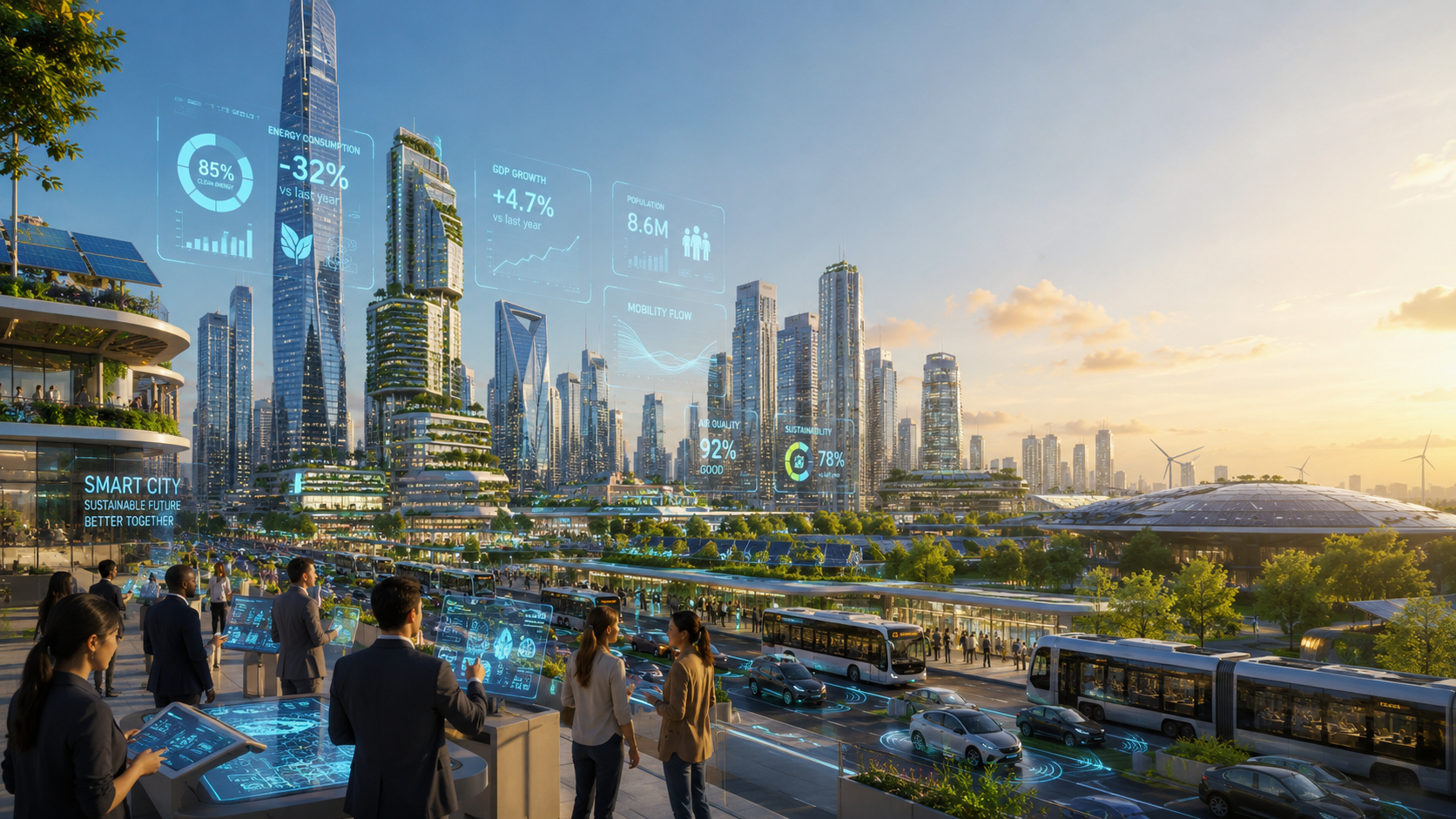
Urbanization is one of the most powerful forces shaping the 21st century. Every week, millions of people around the world move to cities in search of better jobs, education, healthcare, and opportunities. As cities continue to expand, governments and planners face a critical question: How can urban growth be managed sustainably while maintaining economic competitiveness and quality of life?
This is where Urbanization and Smart Cities intersect.
Having spent more than a decade studying urban economics, city development, and economic planning, I have witnessed a remarkable shift in how cities approach growth. Ten years ago, discussions around urban development primarily focused on roads, buildings, and utilities. Today, conversations increasingly revolve around data, digital infrastructure, artificial intelligence, sustainability, and citizen-centric governance.
The concept of urbanization and smart cities is no longer a futuristic vision. It is rapidly becoming a practical necessity for cities seeking to remain economically competitive in an increasingly urbanized world.
The Growing Importance of Urbanization
Urbanization refers to the increasing concentration of population and economic activities in urban areas. According to the United Nations, nearly 70% of the global population is expected to live in cities by 2050.
From my experience working on urban economic studies, one pattern consistently emerges: cities act as engines of economic growth. They attract talent, facilitate innovation, create employment opportunities, and generate higher productivity through economic agglomeration.
However, urbanization also creates significant challenges:
- Traffic congestion
- Housing shortages
- Environmental degradation
- Pressure on infrastructure
- Rising inequality
- Resource constraints
Without proper planning, rapid urbanization can undermine economic growth rather than support it.
This is why Urbanization and Smart Cities have become central themes in modern economic development strategies.
What Is a Smart City?
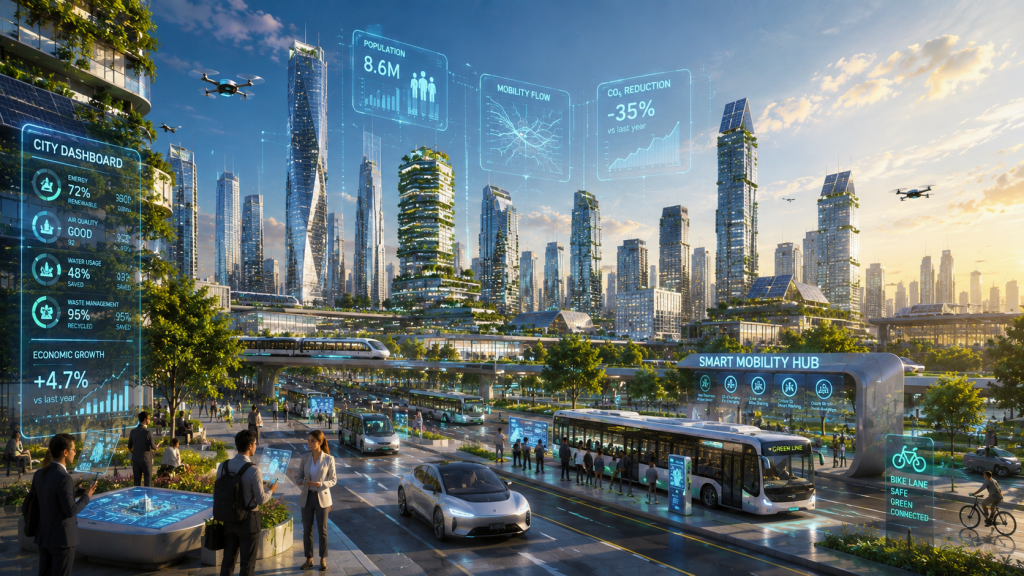
A smart city uses technology, data analytics, digital connectivity, and intelligent infrastructure to improve urban management and enhance the quality of life for residents.
Contrary to popular belief, smart cities are not simply cities filled with technology. The most successful smart cities use technology as a tool to solve real urban problems.
A smart city typically integrates:
Smart Mobility
- Intelligent traffic management
- Smart parking systems
- Autonomous transportation
- Integrated public transit networks
Smart Governance
- Digital government services
- Data-driven decision making
- Citizen engagement platforms
Smart Energy
- Smart grids
- Renewable energy integration
- Energy-efficient buildings
Smart Environment
- Air quality monitoring
- Waste management systems
- Water conservation technologies
Smart Economy
- Innovation ecosystems
- Digital entrepreneurship
- Knowledge-based industries
The true value of Urbanization and Smart Cities lies not in technology itself but in how technology improves urban efficiency and economic productivity.
Why Smart Cities Matter for Future Economies
Over the past decade, I have observed that cities increasingly compete not only for investment but also for talent, innovation, and global relevance.
Future economic success will depend heavily on how effectively cities manage urban growth.
1. Enhancing Productivity
Urban productivity often suffers from traffic congestion, inefficient public services, and fragmented infrastructure.
Smart technologies reduce these inefficiencies by optimizing urban systems.
For example:
- Smart traffic systems reduce travel times.
- Digital permitting accelerates business operations.
- Data analytics improve infrastructure planning.
These improvements directly contribute to economic output.
2. Attracting Investment
Investors increasingly evaluate cities based on infrastructure quality, digital readiness, sustainability, and governance effectiveness.
Cities that embrace smart technologies often become more attractive destinations for:
- Foreign direct investment (FDI)
- Technology companies
- Startups
- Skilled professionals
Cities such as Singapore and Dubai have successfully positioned themselves as innovation hubs through strategic investments in smart city initiatives.
3. Supporting Innovation Ecosystems
Innovation thrives where people, institutions, and businesses interact closely.
Smart cities strengthen innovation ecosystems through:
- High-speed connectivity
- Innovation districts
- Research partnerships
- Startup incubators
These ecosystems generate new industries, jobs, and economic opportunities.
Urbanization and Smart Cities: A Comparison with Traditional Urban Development
| Feature | Traditional City | Smart City |
|---|---|---|
| Infrastructure Management | Reactive | Predictive |
| Traffic Control | Fixed Systems | Real-Time Monitoring |
| Public Services | Manual Processes | Digital Platforms |
| Energy Use | Conventional | Smart Grids |
| Data Utilization | Limited | Extensive Analytics |
| Citizen Engagement | Low | Interactive |
| Economic Development | Infrastructure-Led | Innovation-Led |
| Sustainability | Secondary Focus | Core Objective |
This transition represents one of the most significant shifts in urban planning since the industrial era.
The Role of Data in Smart Cities
One of the biggest transformations I have witnessed over the past decade is the growing importance of urban data.
Cities now generate enormous amounts of information through:
- Sensors
- Cameras
- Mobile devices
- Public transport systems
- Utility networks
When analyzed effectively, this data provides valuable insights into:
- Traffic patterns
- Energy consumption
- Economic activity
- Environmental performance
- Service delivery
The result is better-informed decision-making and more efficient resource allocation.
For students of economics and urban planning, data is becoming as important as physical infrastructure.
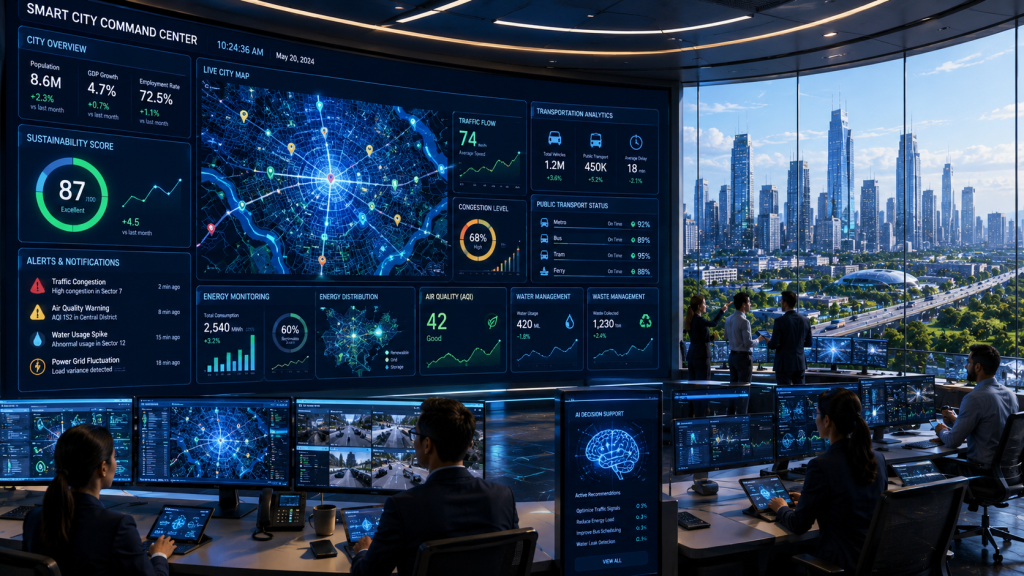
Image Prompt: Urban command center displaying real-time city data dashboards, transportation analytics, energy monitoring systems, and AI-powered decision support tools.
Sustainability and Smart Urban Growth
Sustainability is perhaps the most compelling argument for integrating Urbanization and Smart Cities strategies.
Cities account for a substantial share of:
- Global energy consumption
- Carbon emissions
- Resource utilization
Smart technologies can help reduce environmental impacts through:
Energy Efficiency
Smart buildings automatically optimize energy usage based on occupancy and demand.
Sustainable Transportation
Electric vehicles, intelligent transit systems, and mobility-as-a-service platforms reduce emissions.
Smart Water Management
Advanced sensors detect leaks and improve water distribution efficiency.
Waste Reduction
Data-driven waste collection systems optimize routes and reduce operational costs.
From my experience evaluating urban projects, sustainability initiatives increasingly deliver both environmental and economic benefits.
The old perception that sustainability and economic growth are conflicting objectives is rapidly becoming outdated.
Global Examples of Smart Cities
Several cities have emerged as global leaders in smart urban development.
Singapore
Singapore is widely recognized as one of the world’s most advanced smart cities.
Key initiatives include:
- Smart mobility systems
- Digital government services
- National sensor networks
- Urban digital twins
Barcelona
Barcelona pioneered smart city innovation through:
- Smart lighting
- Intelligent parking systems
- Citizen engagement platforms
Seoul
Seoul has successfully integrated digital governance with urban services.
The city offers extensive e-government services and data-driven urban management systems.
Riyadh
Riyadh is increasingly investing in digital infrastructure, mobility solutions, and smart governance as part of national transformation initiatives.
The Kingdom’s broader vision places strong emphasis on technology-enabled urban development.
Challenges for Urbanization and Smart Cities
Despite their promise, smart cities face several challenges.
Data Privacy
The collection of large amounts of urban data raises legitimate privacy concerns.
Cybersecurity
Connected systems create vulnerabilities that must be protected from cyber threats.
Funding Constraints
Smart infrastructure investments often require substantial upfront capital.
Institutional Capacity
Many municipalities lack the technical expertise needed to manage sophisticated digital systems.
Digital Inclusion
Cities must ensure that technological benefits are accessible to all citizens rather than widening social inequalities.
Addressing these challenges is essential for realizing the full potential of Urbanization and Smart Cities.
Practical Lessons from Ten Years of Observation
After studying urban development projects across different countries, several lessons consistently stand out.
Start with Problems, Not Technology
The most successful smart city initiatives focus on solving real urban challenges rather than deploying technology for its own sake.
Integrate Economic and Urban Planning
Economic planning and urban planning should work together. Cities are economic systems as much as they are physical spaces.
Invest in Human Capital
Technology alone cannot create smart cities. Skilled professionals, effective institutions, and informed citizens remain critical.
Prioritize Data Governance
Cities must establish clear frameworks for data ownership, privacy, and security.
Measure Outcomes
Smart city projects should be evaluated based on measurable outcomes such as:
- Reduced congestion
- Increased productivity
- Lower emissions
- Improved service quality
- Enhanced citizen satisfaction
The Future of Urbanization and Smart Cities
Looking ahead, the relationship between Urbanization and Smart Cities will become even more important.
Emerging technologies are expected to reshape urban development:
Artificial Intelligence
AI will increasingly support urban decision-making and predictive planning.
Digital Twins
Virtual city models will enable planners to simulate development scenarios before implementation.
Autonomous Mobility
Self-driving vehicles may fundamentally transform urban transportation systems.
Internet of Things (IoT)
Connected devices will continue expanding real-time urban intelligence.
Climate-Resilient Infrastructure
Cities will increasingly integrate smart technologies to adapt to climate risks.
These developments are likely to redefine how cities grow, compete, and create economic value.
Conclusion
The future of economic development is increasingly urban, so, the concept of Urbanization and Smart Cities is central theme of modern world. Cities will remain the primary centers of innovation, investment, entrepreneurship, and productivity.
However, urban growth alone does not guarantee prosperity. Success will depend on how effectively cities manage growth, utilize technology, and create sustainable environments for businesses and residents.
Over the past decade, one lesson has become increasingly clear to me: the cities that combine strategic planning, digital innovation, sustainability, and inclusive governance will become the economic leaders of tomorrow.
The journey toward smarter cities is not merely about technology. It is about building resilient, competitive, and livable urban economies capable of thriving in a rapidly changing world.
For policymakers, economists, planners, students, and citizens alike, understanding Urbanization and Smart Cities is no longer optional—it is essential for shaping the future economy. Just there is need of integrating urbanization and smart cities strategies.
